

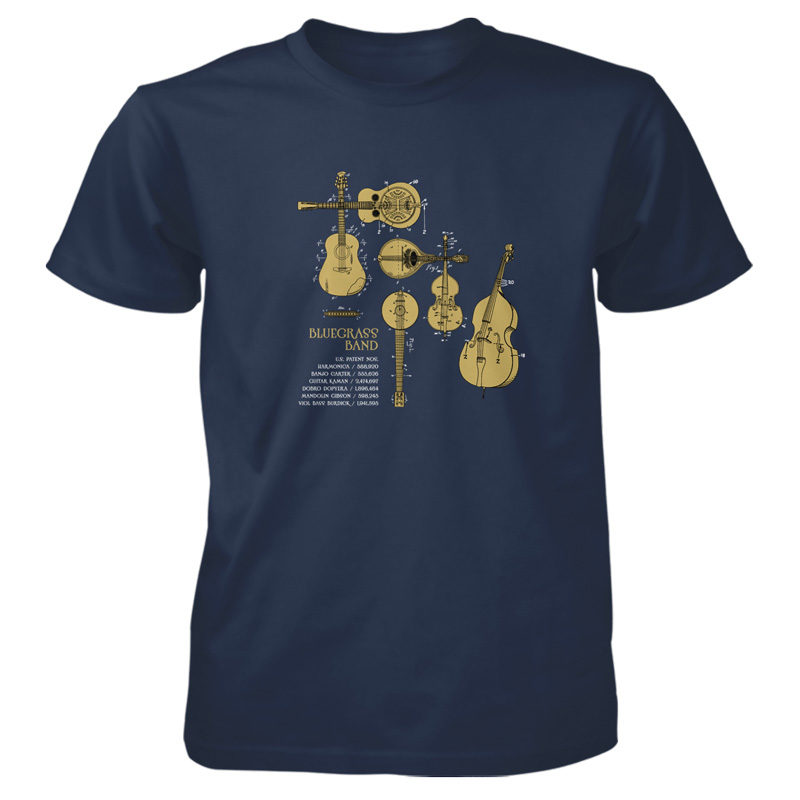
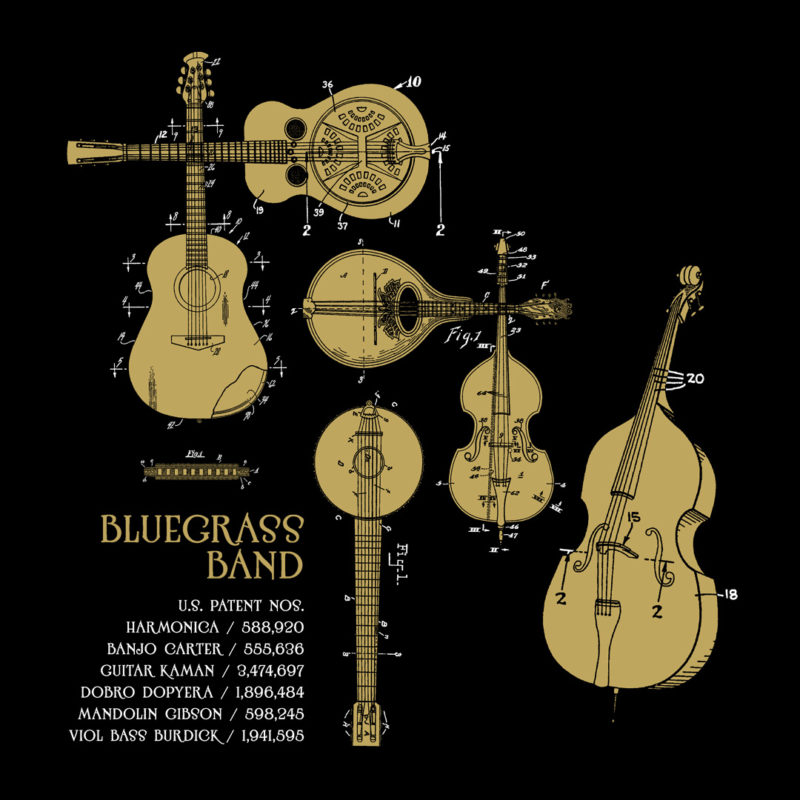
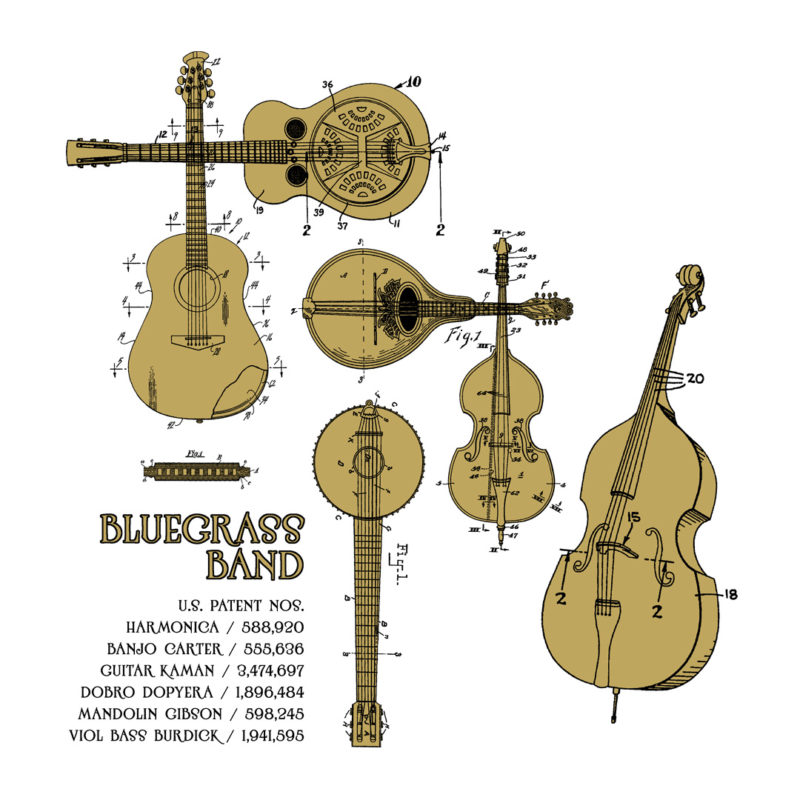
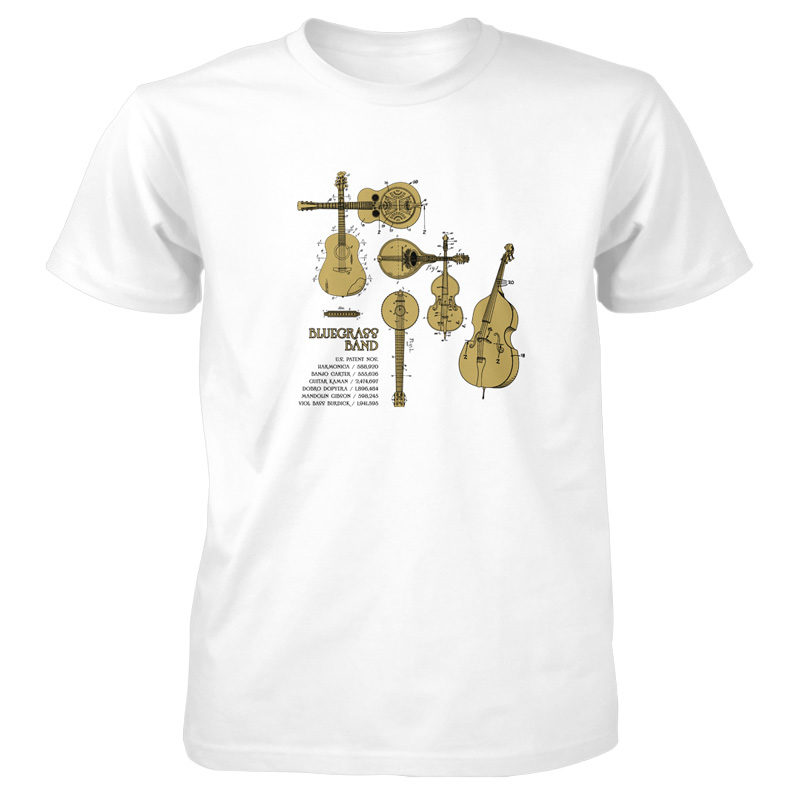
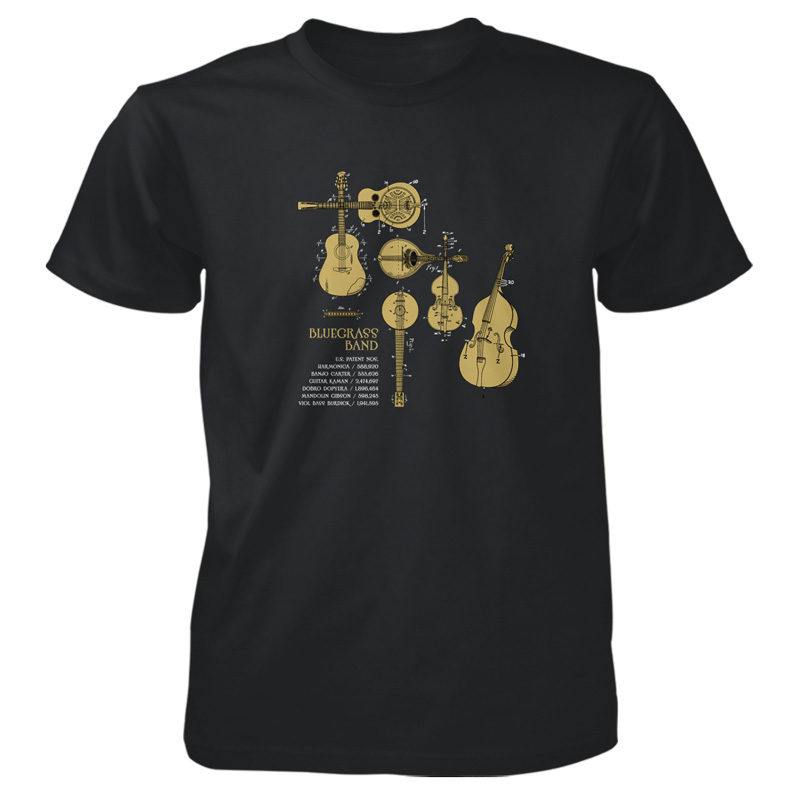
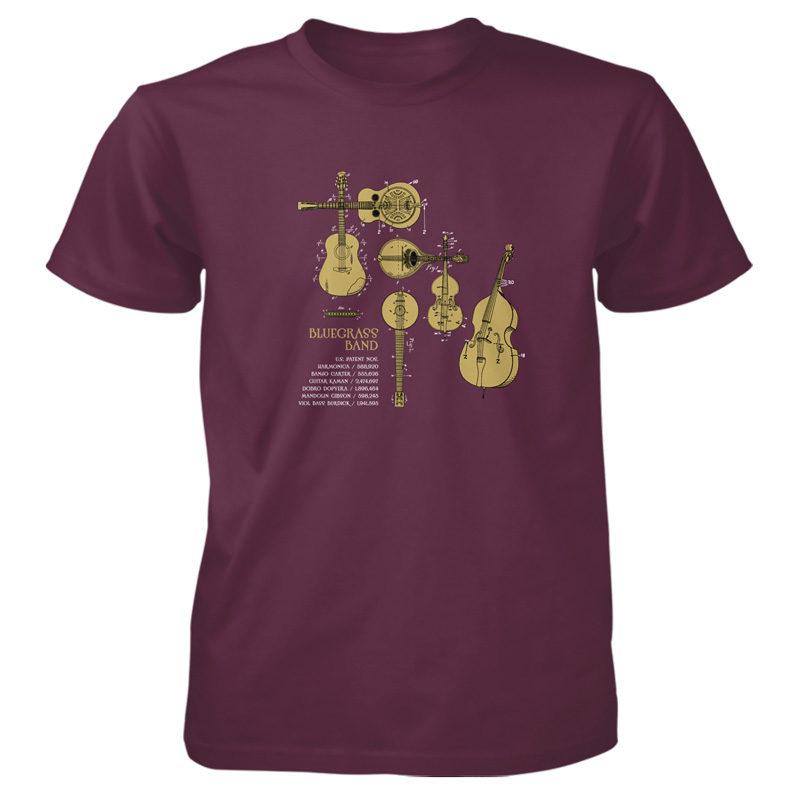
Bluegrass Band Patents T-Shirt
$28.00
See The Story of this design in tab, below.
Our original PatentWear Bluegrass Band patents design is printed in full color on a classic pre-shrunk 100% cotton men’s/unisex t-shirt using an eco-friendly water-based ink process, in shirt colors as indicated. The large design is printed on the front only. Some element colors in the design change slightly depending upon whether it is printed on a dark or light shirt.
THE STORY
What makes a Bluegrass Band? The only real consensus today is that the classic, traditional bluegrass band consists of five instruments: a banjo, an acoustic guitar, the fiddle (aka violin), a mandolin, and an upright bass (aka double bass viol). Although mandolinist Bill Monroe—considered to be the “Father of Bluegrass”—supposedly once said that the dobro guitar “ain’t a part of nothing,” the dobro has become an accepted and popular addition to the modern bluegrass band, along with the less-common harmonica and other occasional additions like the autoharp, accordion, and electric bass.
Most would agree that the defining sound of traditional bluegrass includes two- and three-part harmony singing with that distinctive “high lonesome voice” and stories told through a series of verses with instrumental solos that enter between choruses. The structure of instrumental bluegrass is usually two A parts followed by two B parts. Contrasted with traditional bluegrass, a modern band may play bluegrass instruments, but the singing does not include the “high lonesome voice” and instead may sound more like rock or pop styles. With modern bluegrass bands, instrumentals are often less structured, and follow more of a “jam” format, not unlike jazz.
Although the very mixed roots of bluegrass are in rural Appalachian culture, Irish, Scottish, and English traditional music, and later influences of jazz elements introduced through the music of African-Americans, the commercial musical genre of bluegrass recognized today probably owes its greatest debt to Bill Monroe and his Blue Grass Boys band, named for his home “Blue Grass State” of Kentucky.
Monroe’s band, originally formed in 1938 with the traditional five instruments, was regularly broadcast on the Grand Ole Opry radio program throughout the 1940s. Monroe’s signature style of country music that emphasized instrumental solos and virtuosity, precise and lightning-fast rhythms, vocal harmonies that were sung with a “high lonesome voice,” and alternating instrumental solos defines the traditional genre of bluegrass to this day.
Bluegrass was further refined as Monroe’s band stabilized in 1948 with both repertoire and its core musicians. One member, Earl Scruggs, popularized a new technique for the banjo, in which chords were played as rapid and extremely ornamented arpeggios with three picking fingers instead of melodies or strumming. Due to fatigue, Scruggs and vocalist/guitarist Lester Flatt left the band at the height of its popularity, but later formed their own band, The Foggy Mountain Boys, which also became famously popular due to the finger-picking style of Scruggs and the smooth vocals of Flatt’s. A third iteration of bluegrass innovators can be attributed to the Stanley Brothers, Carter and Ralph. They emphasized the older musical traditions of ballads, and thus forever bound the bluegrass tradition to history and nostalgia as its aesthetics.
With the advent of rock and roll music in the 1950s, bluegrass has periodically taken a back seat in popularity, but it has proven to be a hardy genre that has maintained adherence to its own rules of identity through many decades. It serves both as a template applied to other kinds of music, known as “Pickin’ On… [insert Dylan, the Beatles, etc.] or, it can allow enough flexibility to absorb other musical characteristics—such as different instruments and voices—without losing its own identity.
Bill Monroe remained a bluegrass purist to the end, and his influence endures to this day, but pride in the technical abilities of bluegrass musicians has now forwarded the evolution of their genre into many other innovative song forms, to be further enjoyed by whole new generations of enthusiasts.
Sizing | Fit | Care: Unisex T-Shirt
- 100% cotton (except Sport Grey=10% polyester)
- 5–5.3 oz. fabric weight
- Pre-shrunk jersey knit
- Taped neck and shoulders
- Tear-away tag
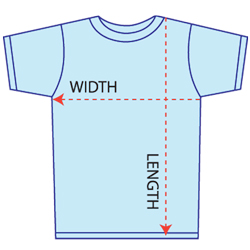
| USA/INCHES Sizes: Unisex/Men’s T-Shirt | ||||||
|---|---|---|---|---|---|---|
| 1″ = 2.54 cm | S | M | L | XL | 2XL | 3XL |
| Chest (inches) | 36 | 40 | 44 | 48 | 52 | 56 |
| Width (inches) | 18 | 20 | 22 | 24 | 26 | 28 |
| Length (inches) | 28 | 29 | 30 | 31 | 32 | 33 |
| CENTIMETERS Sizes: Unisex/Men’s T-Shirt | ||||||
|---|---|---|---|---|---|---|
| 2.54 cm = 1″ | S | M | L | XL | 2XL | 3XL |
| Chest (cm) | 96 | 102 | 112 | 122 | 132 | 142 |
| Width (cm) | 45.7 | 51 | 56 | 61 | 66 | 71 |
| Length (cm) | 74 | 76 | 78 | 79 | 81 | 83.8 |
CARE:
Machine wash, cold, inside out, gentle cycle with mild detergent and similar colors. Use non-chlorine bleach—only when necessary No fabric softeners.
Tumble dry, low heat, or hang-dry for longest life.
Cool iron inside-out if necessary. Do not iron decoration or print.
Do not dry clean.
Related products
-

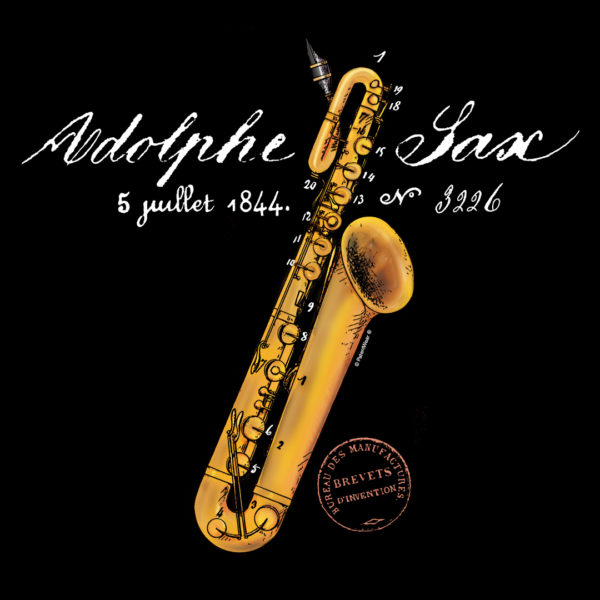
Sax Solo Patent T-Shirt
$28.00Select options This product has multiple variants. The options may be chosen on the product page -
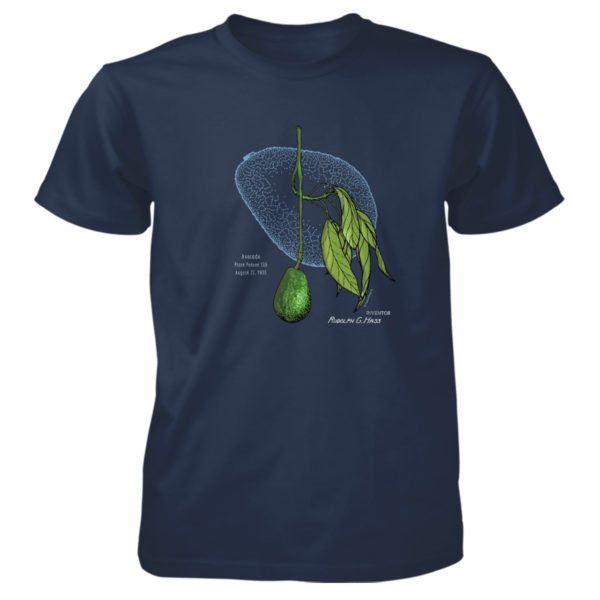
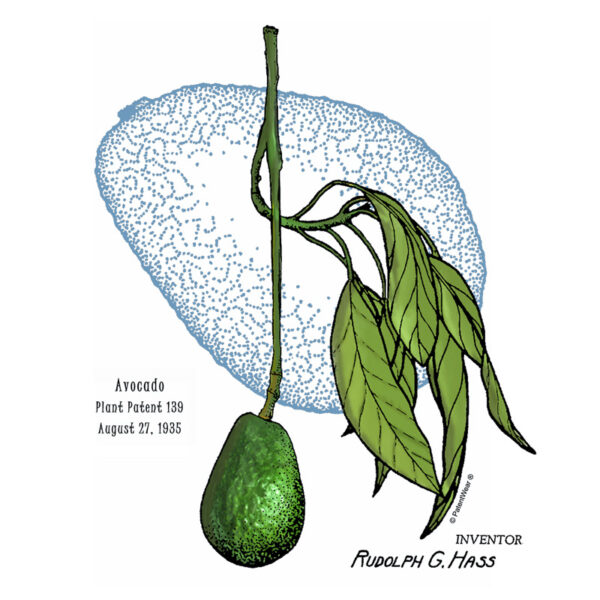
Avocado Patent T-Shirt
$28.00Select options This product has multiple variants. The options may be chosen on the product page -
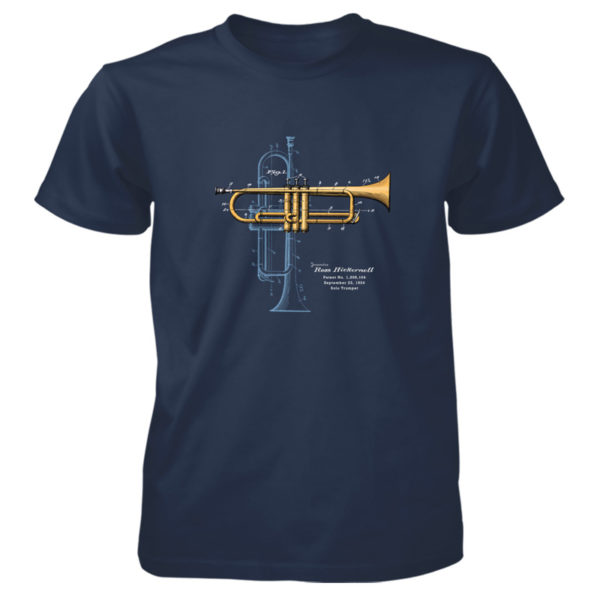

Trumpet Solo Patent T-Shirt
$28.00Select options This product has multiple variants. The options may be chosen on the product page -
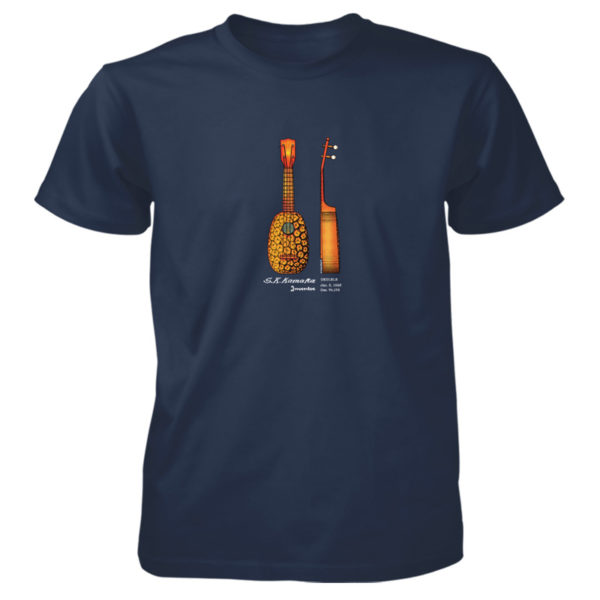

Pineapple Ukulele Patent T-Shirt
$28.00Select options This product has multiple variants. The options may be chosen on the product page