

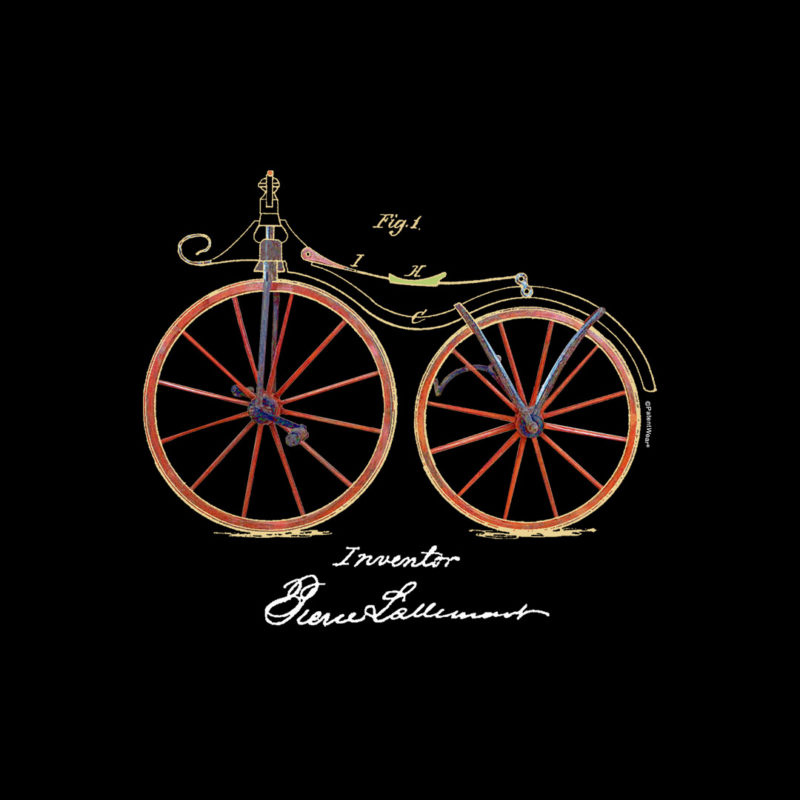


Velocipede Patent Women’s Racerback Tank
$24.00
See The Story of this design in tab, below.
The USA’s first bicycle patent, our Velocipede patent design is printed on a women’s racerback tank that is soft, lightweight, and form-fitting with a flattering cut and raw edge seams for an edgy touch.
• 50% polyester/25% combed ring-spun cotton/25% rayon
• Fabric weight: 4.2 oz (142 g/m2)
• Raw edge seams
• Fabric is laundered to reduce shrinkage
• Fit type: Misses
The Story
The modern bicycle owes its development to a host of inventors and their ideas from numerous countries, but the patent depicted here in our Velocipede design, granted to Pierre Lallement on November 20, 1866, is considered America’s first.
Frenchman Pierre Lallement was born poor in 1843, near Nancy, France, where he later learned blacksmithing, and worked building baby carriages. There, he’d seen his first laufmaschine (German for “running machine”), earlier introduced by the German Baron von Drais. Patented in France in 1818, and popularized for a while in both England and America by the rich “dandies” who rode them (only a rich man could afford one), it was also known as the “draisine” or, hobby horse (and even “dandy horse”) after the child’s toy, likewise straddled, and then pushed along using alternate feet in a running motion. The Drais design was the first commercially-successful, two-wheeled, human-propelled machine, initially manufactured in Germany and France. Though its similarity to the bicycle stopped at two wheels and the straddling position of the rider, Lallement was the visionary who saw past trusting two points of support only when one foot could provide a third point to preserve uprightness.
At 19, Lallement moved to Paris, where, in his spare time, he put together the machine he first called a “veloce” using rotary cranks and pedals mounted to the front wheel hub. The first pedals were of round wooden spools, but he made a pair of square wooden pieces with sheet iron on top and weight on the bottom to keep them right side up. His first experimental machine completed, the difficult task was then learning to ride it without benefit of instruction or knowledge of any previous riders. In July 1863, he first rode it publicly on the Boulevard Saint Martin where, he said, “all the people saw it.”
Though some people wondered and many more laughed, Lallement’s ongoing experiments convinced him that the idea of a pedal-driven bicycle was practical, and that it had potential for popular success. However, without resources, he looked to America for quicker and more profitable opportunities. He arrived in New York by steamer in July 1865 with his two wheels and a newly-forged wrought-iron perch (a somewhat shock-absorbing saddle configuration) from Paris, found work in Ansonia, Connecticut, and continued to perfect his machine. By the fall of 1865, he was able to regularly ride it as transportation to work, and even completed an exhibition road trip of about 4.5 miles to convince skeptics, from whom he was trying to obtain financial backing, that its qualities were adequate for road use.
In early 1866, Lallement finally found Mr. James Carroll in New Haven, a man willing to advance the money necessary to obtain a patent (and take a half-interest). On May 4th, 1866, Lallement filed his specification, model, and drawings with the U.S. Patent Office—îthe world’s first public record of the bicycle. Yet, neither man had the wherewithal to make it profitable, and so, Lallement eventually returned to Paris. While many patented improvements were subsequently made, the original Lallement patent became valuable, and in after an exhaustive search to ascertain the validity of the patent in 1868, the two men’s interests in it were purchased by Calvin Witty, to whom future makers also paid royalties. Lallement received 10,000 francs for his half—the only direct pecuniary award he ever got for his invention.
Although Lallement later died in obscurity in Boston at the age of 47, he is not forgotten. In 1998, a monument to Lallement was unveiled in New Haven as part of the city’s International Festival of Arts & Ideas, and he was inducted into the United States Bicycling Hall of Fame in 2005. Additionally, a three-and-a-half-mile section of Boston’s bike network is named the Pierre Lallement Bike Path. It passes not far from the house where Lallement died in 1891.
Sizing & Fit | Women’s Racerback Tank
Fit type: Misses. Primary brand: Next Level.
- 150% polyester, 25% combed ring-spun cotton, 25% rayon
- Fabric weight: 4.2 oz/yd² (142 g/m²)
- Fabric is laundered to reduce shrinkage
- Satin label
- Raw edge seams
Machine wash cold, inside-out, gentle cycle with mild detergent and similar colors. Use
non-chlorine bleach, only when necessary. No fabric softeners. Tumble dry low, or hang-dry for longest life. Cool iron inside-out if necessary. Do not dry clean.
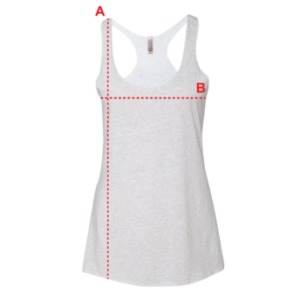
Find Your Size: If you’re unsure about sizing, an easy way to determine a correct size is to grab an existing favorite, lay it flat, and then measure it.
A LENGTH: Place the end of a tape measure beside the collar at the top of the tank top. (Highest point shoulder). Pull the tape measure to the bottome of the shirt.
B WIDTH: Place the end of the tape measure at the seam under the sleeve and pull it across the shirt to the seam under the opposite sleeve.
| USA Sizes: Women’s Racerback Tank Top |
|||||
|---|---|---|---|---|---|
| 1″ = 2.54 cm | XS | S | M | L | XL |
| Bust (inches) | 30 | 32 | 34 | 36 | 38 |
| Width (inches) | 15 ¼ | 16 ¼ | 17 ¼ | 18 ¼ | 19 ¼ |
| Length (inches) | 26 ⅛ | 26 ¾ | 27 ⅜ | 28 | 28 ⅝ |
| METRIC Sizes: Women’s Racerback Tank Top |
|||||
|---|---|---|---|---|---|
| 2.54 cm = 1″ | XS | S | M | L | XL |
| Bust (cm) | 76 | 82 | 96 | 92 | 98 |
| Width (cm) | 38.7 | 41.3 | 43.8 | 46.4 | 49 |
| Length (cm) | 66.4 | 68 | 69.5 | 71 | 72.7 |
Related products
-


Hobie Cat Patent Women’s Racerback Tank
$24.00Select options This product has multiple variants. The options may be chosen on the product page -

Jardine Cam Patent Women’s Racerback Tank
$24.00Select options This product has multiple variants. The options may be chosen on the product page -

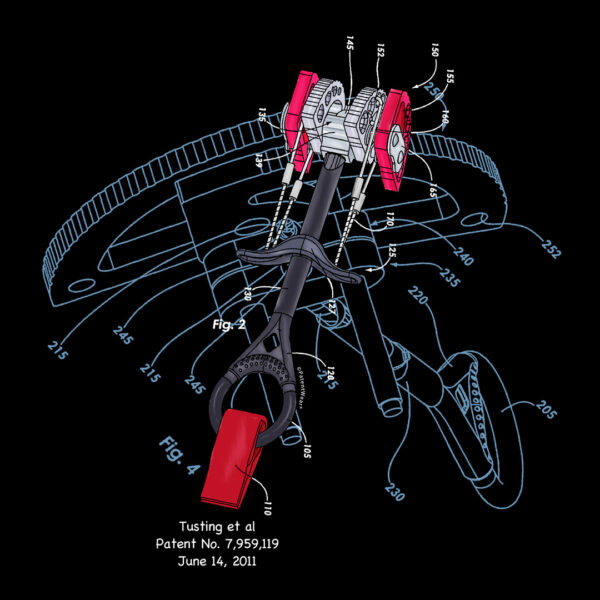
Cam C4 Patent Women’s Racerback Tank
$24.00Select options This product has multiple variants. The options may be chosen on the product page -
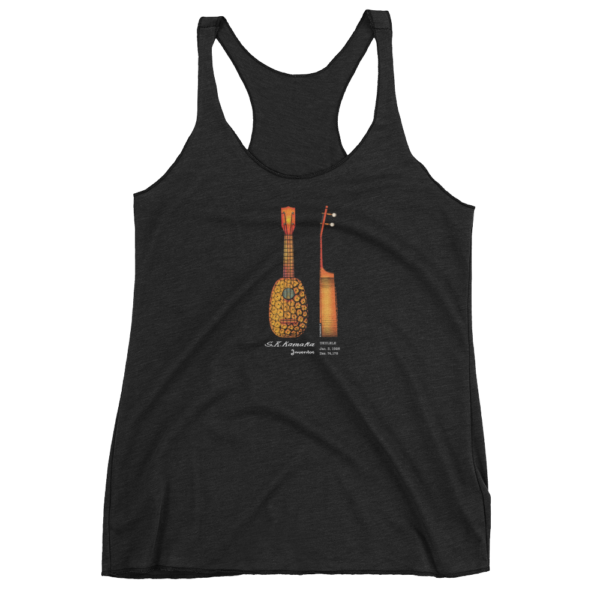

Pineapple Ukulele Patent Women’s Racerback Tank
$24.00Select options This product has multiple variants. The options may be chosen on the product page