


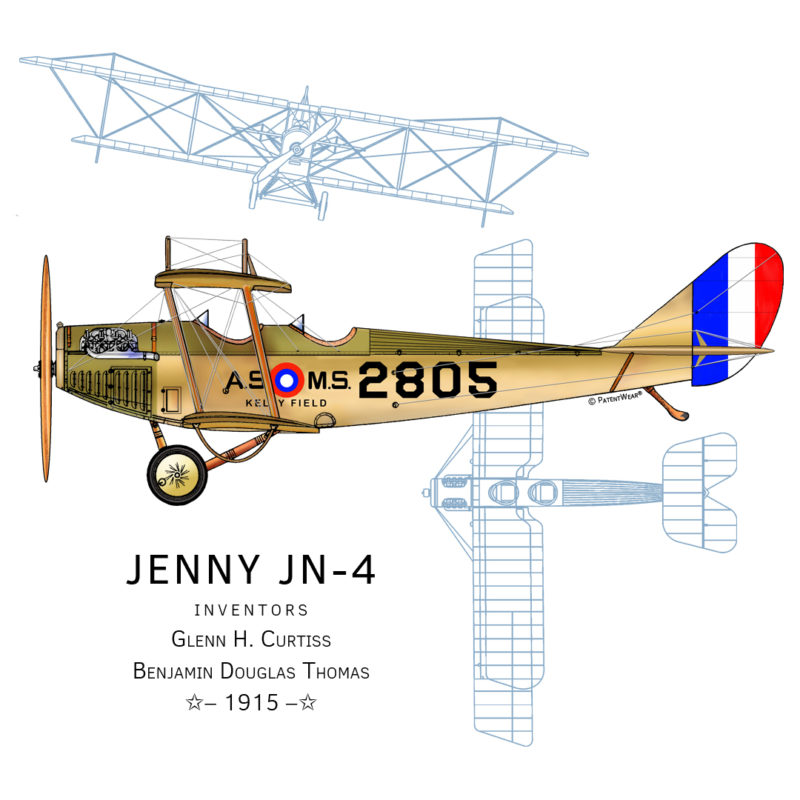


Jenny JN-4 T-Shirt
$28.00
See The Story of this design in tab, below.
Our original PatentWear Jenny JN-4 design printed in full color on a classic pre-shrunk 100% cotton men’s/unisex t-shirt using an eco-friendly water-based ink process, in shirt colors as indicated. The large design is printed on the front only. Some element colors in the design change slightly depending upon whether it is printed on a dark or light shirt.
The Story
Often called the “Model T Ford of the Air,” the Curtiss Jenny JN-4 is arguably one of the most famous aircraft designs in U.S. aviation history. The first mass-produced airplane, it was a highly maneuverable, lightweight, slow-moving, twin-seat, biplane with dual control. Its student in front and instructor behind configuration made it ideal for initial pilot training, and after the war, for exciting barnstormer joyrides.
The Jenny JN-4 was designed and built as a military trainer, and was used to train 95% of all WWI US and Canadian pilots. By the Armistice in 1918, well over 6,000 JN-4s had been built, including planes for Canada, Britain, France and Australia. As trainers, however, none ever saw active service.
The Jenny JN-4 is really a hybrid of two designs: the Jenny J and the Jenny N. The Model J was designed by Benjamin D Thomas, a talented young British engineer who formerly worked for the Sopwith Aviation Company in Britain. Glen Curtiss commissioned Thomas for the design, and its first flight was in May 1914. Concurrently Curtiss was working on his own design, the Model N which was a parallel design to the Model J of 1914, differing in primarily in the airfoil details. In 1915, the best features of the J and N Models were combined to produce the JN-1, and eventually, the definitive JN-4.
The Jenny airframe structure was almost entirely wooden with a doped fabric covering typical of the period. Her fuselage and wings were framed with spruce and ash and interconnected with vast amounts of wire and turnbuckles. The wire rigging contributed to the structural integrity and allowed for light displacement yet rugged strength, and furthermore, she could be tuned, similar to a modern sailboat rig.
The JN-4 Jenny was powered by the Curtiss OX-5, a 90 hp, V-8 liquid-cooled engine that gave it a cruising speed of 60 mph and a top speed of 75 mph. The OX-5 has the distinction of being the first mass-produced aircraft engine in the U.S. It was designed by Curtiss, assisted by his talented engineers Henry Kleckler and Charles Kirkham. The original OX-5 steel and copper parts were nickel plated, making it a beautiful sight to behold.
The famous Jenny’s career, during the post-war years, was even more illustrious. With the war ended, hundreds of trained pilots available, and a surplus of planes and engines, the aviation boom that took place was inevitable. A complete Jenny could be purchased for as little as $300, and an OX engine for $75. The period from 1920-26, known as the Jenny Era, is when hundreds of military pilots—and those who first learned to fly in a Jenny—purchased their own Jennys and embarked on careers in Flying Circuses, and, as Barnstormers. The U.S. Postal Service used Jennys as one of the nation’s first mail carriers, for airmail service on the route between Washington, D.C., Philadelphia, and New York in 1918.
Also in 1918, one of the most famous philatelic errors in American history involved the Jenny. Known as the Inverted Jenny, the postage stamp was first issued on May 10, 1918. The image in the center of the design, a Curtiss JN-4 airplane, was printed upside down. For a sense of this error’s worth, a block of four inverted Jennys sold at an auction in 2007 for US $2.7 million, but, since the financial crisis of 2008, sell prices have dropped to a mere US$125,000-$575,000.
Many of the renowned aviators of the day honed their skills in Jennys, including Charles Lindbergh and Amelia Earhart. The Jenny was the first plane to introduce flying to the American public, and to popularize aviation. From the ranks of early Jenny pilots came the men who founded commercial aviation in America. Thanks to the Jenny Era, America was awakened to aviation.
Our Jenny illustrated is the production Model JN-4, staggered wings and prototype wheels as used in the Air Service Mechanic’s School, Kelly Field, Texas.
Sizing | Fit | Care: Unisex T-Shirt
- 100% cotton (except Sport Grey=10% polyester)
- 5–5.3 oz. fabric weight
- Pre-shrunk jersey knit
- Taped neck and shoulders
- Tear-away tag
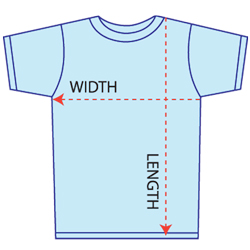
| USA/INCHES Sizes: Unisex/Men’s T-Shirt | ||||||
|---|---|---|---|---|---|---|
| 1″ = 2.54 cm | S | M | L | XL | 2XL | 3XL |
| Chest (inches) | 36 | 40 | 44 | 48 | 52 | 56 |
| Width (inches) | 18 | 20 | 22 | 24 | 26 | 28 |
| Length (inches) | 28 | 29 | 30 | 31 | 32 | 33 |
| CENTIMETERS Sizes: Unisex/Men’s T-Shirt | ||||||
|---|---|---|---|---|---|---|
| 2.54 cm = 1″ | S | M | L | XL | 2XL | 3XL |
| Chest (cm) | 96 | 102 | 112 | 122 | 132 | 142 |
| Width (cm) | 45.7 | 51 | 56 | 61 | 66 | 71 |
| Length (cm) | 74 | 76 | 78 | 79 | 81 | 83.8 |
CARE:
Machine wash, cold, inside out, gentle cycle with mild detergent and similar colors. Use non-chlorine bleach—only when necessary No fabric softeners.
Tumble dry, low heat, or hang-dry for longest life.
Cool iron inside-out if necessary. Do not iron decoration or print.
Do not dry clean.
Related products
-
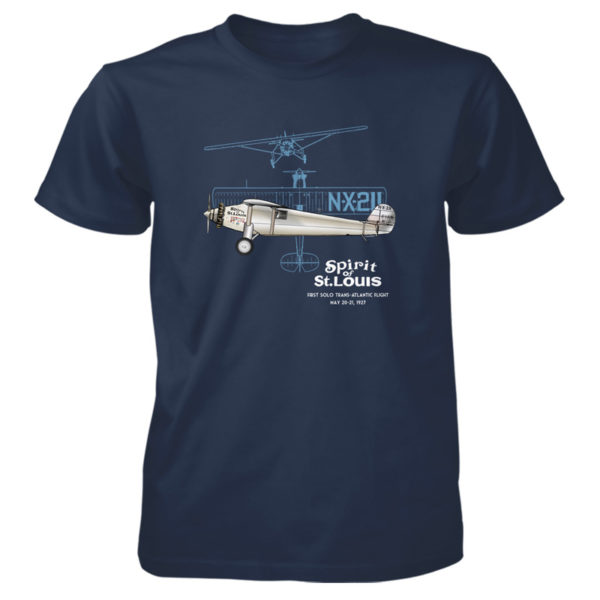
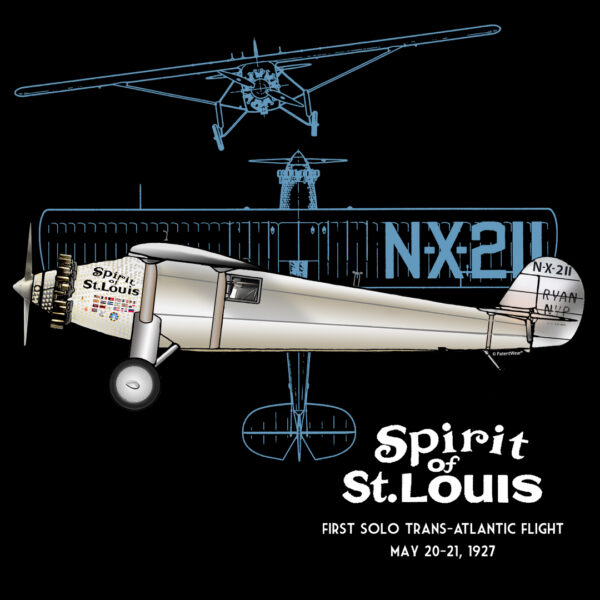
Spirit of St Louis T-Shirt
$28.00Select options This product has multiple variants. The options may be chosen on the product page -


Flight Dreams Patent T-Shirt
$28.00Select options This product has multiple variants. The options may be chosen on the product page -
Lilienthal Glider Patent T-Shirt Line Art
$28.00Select options This product has multiple variants. The options may be chosen on the product page -


Bicycles MS|Color T-Shirt
$28.00Select options This product has multiple variants. The options may be chosen on the product page