

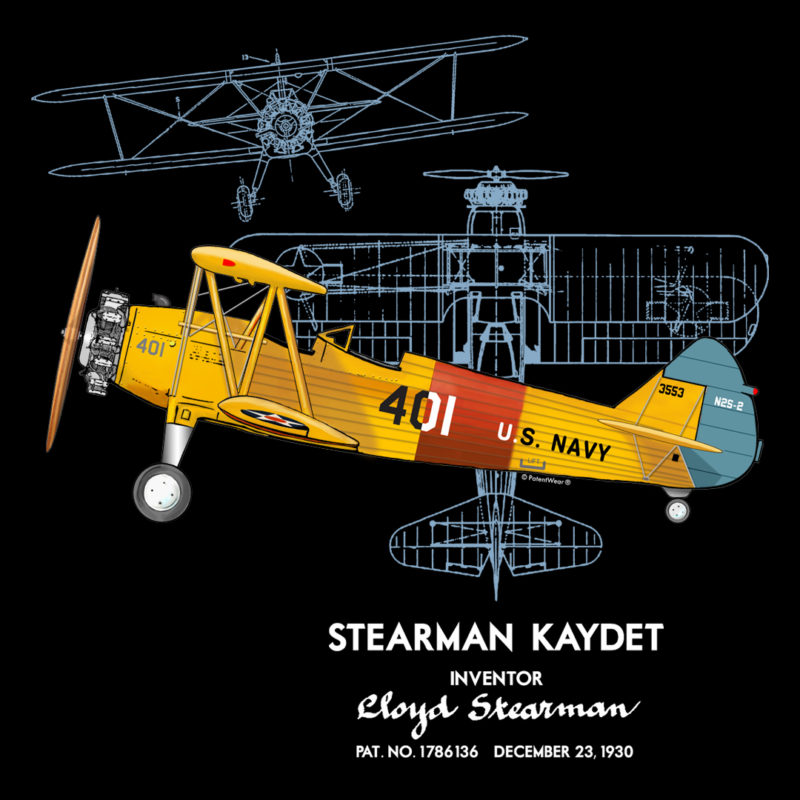


Stearman Kaydet Patent T-Shirt
$28.00
See The Story of this design in tab, below.
Our original PatentWear Stearman Kaydet design is printed in full color on a classic pre-shrunk 100% cotton men’s/unisex t-shirt using an eco-friendly water-based ink process, in shirt colors as indicated. The large design is printed on the front only. Some element colors in the design change slightly depending upon whether it is printed on a dark or light shirt.
The Story
The design of the Stearman two-seater biplane—first introduced in 1934—was nearly obsolete by the time WWII began, but its revival as an unexpected success was renowned. Its simple yet rugged construction was ideal for use as the primary trainer for both U.S. Army Air Corps and U.S. Navy pilots during WWII. Thousands of RAF (Royal Air Force) pilots also earned their wings with the Stearman during the war years.
Easy to fly, and relatively forgiving of new pilots, the Stearman was also easy to maintain and repair—key considerations with student pilots. Its reputation as a rugged airplane and a good teacher was well-founded. The Stearmans were simple yet robust aircraft, with fabric-covered wooden wings, and single-leg landing gear. The fuselage, which was also fabric-covered, was built of welded steel. Only radial engines were used, and most models were equipped with either the Continental R-680, 220hp (Navy Model N2S) or the Lycoming R-680, at 225 hp (Army Model PT).
Lloyd Stearman was a well-known designer, notably of the legendary Stearman biplanes which had been in service with the first commercial American airlines during the 1920s. His rugged Model C-3 and C-4 “Speedmail” biplanes featured large compartments for mail service, and were the first to cross the continent carrying U.S.(Air) Mail. In the early 1930s, Mac Short, Jack Clark, and Harold Zipp—engineers at the Stearman Company—designed and built a training airplane for the U.S. military, the prototype of which was named the Model 70. The design was based on Lloyd Stearman’s last biplane design, the Model 6 “Cloudboy.” Later modifications led to the Model 75 which became the standard trainer for pilots in the U.S. Army and Navy. However, by then, Stearman had left the company and it had become a subsidiary of Boeing Aircraft Company.
The Army dubbed the two-seater plane the “PT,” the Navy called it the “N2S” and “Kaydet” was derived from Canadian forces but also encouraged by the U.S. government promoting popular names (instead of type numbers) for public reference to military aircraft during the war. Though nearly the exact same aircraft, they were differentiated physically early on, with the Army fuselage painted blue and the Navy’s painted yellow. The Stearman Aircraft Company was eventually incorporated as the Stearman Aircraft Division of Boeing in 1938, and the planes were produced at the Boeing factory in Wichita, Kansas. By the end of WWII, 8.428 had been built, with enough spare parts to assemble another 2,000. Officially named the Boeing Model 75, or “Boeing Kaydet,” the plane was—and still is—best known as the “Stearman.”
After the war, thousands of Stearman Kaydets became available on the war surplus market. Some were used for aerobatic competitions and others were converted to crop dusters. Many were outfitted with brand new war surplus R-985 Pratt and Whitney Wasp Junior radial engines rated at 450hp, over twice the original power. With its strong airframe, high lift and large wheels the Stearman was capable of landing and taking-off from short or rough places like fields, farmland or gravel roads.
Today, the Kaydet is popular among antique airplane enthusiasts who seek to recapture the spirit of a bygone era with a variety of color schemes reminiscent of WWII era graphics. A fitting tribute to a truly historic airplane, the Stearman Kaydet has now become a beloved collector’s item for aviation aficionados.
Lloyd Stearman had an illustrious career in his 77 years. With an early background in engineering and architecture, he became a seaplane pilot in the U.S. Navel Reserve, an airplane mechanic, the founder of the Stearman Aircraft Corporation, and later served as president of Lockheed Aircraft Company, overseeing the design and introduction of the Lockheed 10 Electra. In recognition of his contributions to the aircraft industry, Lloyd Stearman was inducted into the National Aviation Hall of Fame in Dayton Ohio in July 1989.
Sizing | Fit | Care: Unisex T-Shirt
- 100% cotton (except Sport Grey=10% polyester)
- 5–5.3 oz. fabric weight
- Pre-shrunk jersey knit
- Taped neck and shoulders
- Tear-away tag
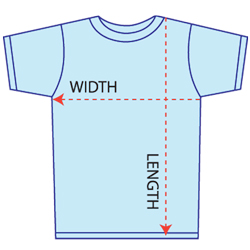
| USA/INCHES Sizes: Unisex/Men’s T-Shirt | ||||||
|---|---|---|---|---|---|---|
| 1″ = 2.54 cm | S | M | L | XL | 2XL | 3XL |
| Chest (inches) | 36 | 40 | 44 | 48 | 52 | 56 |
| Width (inches) | 18 | 20 | 22 | 24 | 26 | 28 |
| Length (inches) | 28 | 29 | 30 | 31 | 32 | 33 |
| CENTIMETERS Sizes: Unisex/Men’s T-Shirt | ||||||
|---|---|---|---|---|---|---|
| 2.54 cm = 1″ | S | M | L | XL | 2XL | 3XL |
| Chest (cm) | 96 | 102 | 112 | 122 | 132 | 142 |
| Width (cm) | 45.7 | 51 | 56 | 61 | 66 | 71 |
| Length (cm) | 74 | 76 | 78 | 79 | 81 | 83.8 |
CARE:
Machine wash, cold, inside out, gentle cycle with mild detergent and similar colors. Use non-chlorine bleach—only when necessary No fabric softeners.
Tumble dry, low heat, or hang-dry for longest life.
Cool iron inside-out if necessary. Do not iron decoration or print.
Do not dry clean.
Related products
-
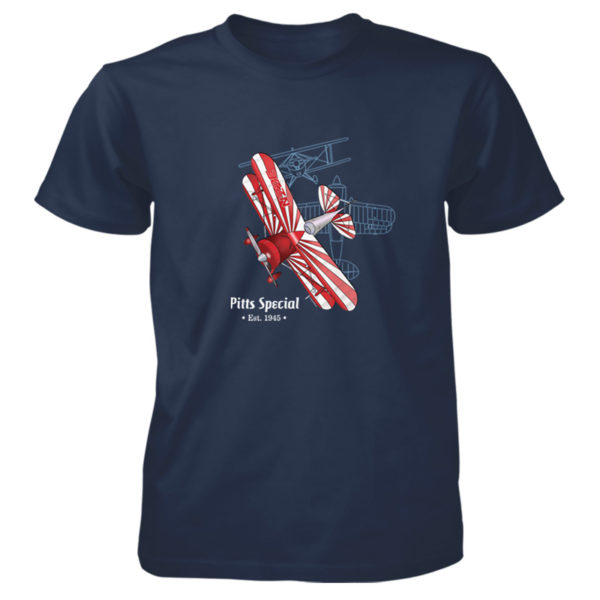

Pitts Special T-Shirt
$28.00Select options This product has multiple variants. The options may be chosen on the product page -


P-51 Mustang T-Shirt
$28.00Select options This product has multiple variants. The options may be chosen on the product page -
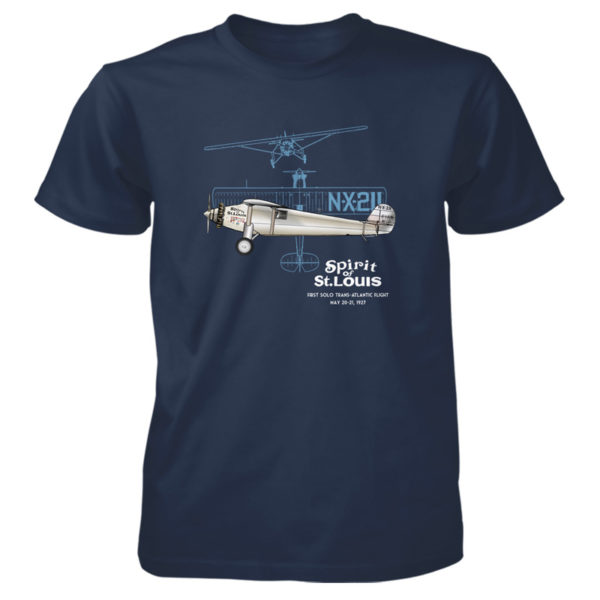
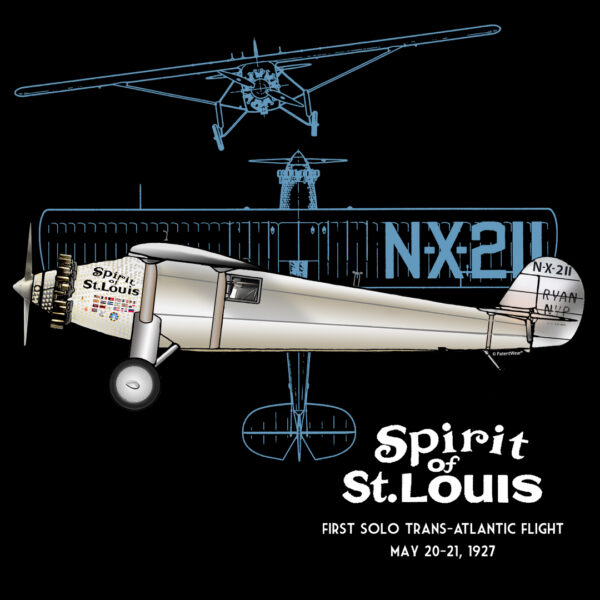
Spirit of St Louis T-Shirt
$28.00Select options This product has multiple variants. The options may be chosen on the product page -
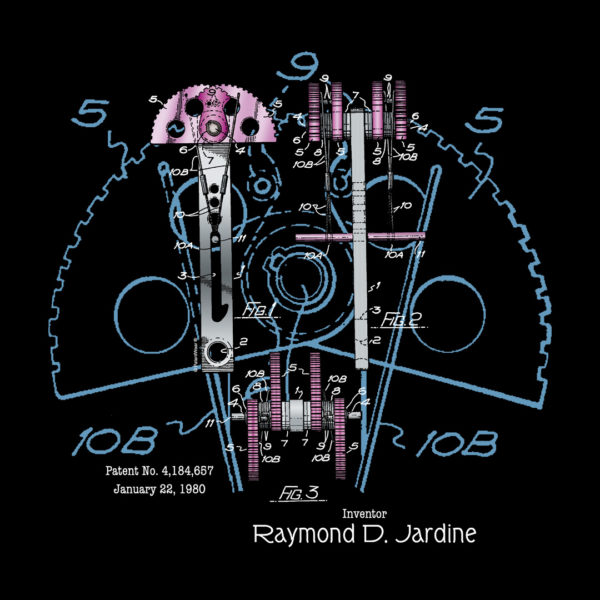
Jardine Cam Patent T-Shirt
$28.00Select options This product has multiple variants. The options may be chosen on the product page